
Tools and the Development of Contemporary Society

Featured Book
Guns, Germs, and Steel
The Fates of Human Societies
Jared Diamond
Paperback edition 1999
Geographical and ecological advantages, not differences in people, gave Eurasians a head start on the rest of the world.
At the time of colonization, the Europeans had a food production system in place that produced enough surplus to allow large parts of their society to engage in other activities, including war. They had better technology such as steel weapons and horses, a writing system that allowed them to share knowledge across generations and finally, over time they had developed immunity to diseases such as smallpox that they took with them to the New World.
Read More from This Report
Environment Matters »
Intelligence and Adaptability »
Food Production and Its Advantages »
Characteristics Favoring Domestication »
Why Didn’t Other Locations with a Mediterranean Climate Develop Indigenous Agriculture »
Geographical Advantage of an East-West Axis »
Food Production: Precursor to Technology, Central Government, Literacy and Germs »
Advantage of Disease and Immunity »
Advantages of Early Technology »
Facts that led to Eurasian Technological Advances »
Politics and Governments »
Australia and New Guinea: Limited by Climate and Geography »
China: Relative Isolation and Early Unification »
Polynesia: Population Expansion from China »
The Americas: Population Replacement by Europeans »
Africa: History, Diversity, and the Advantage of Agriculture »
Cultural and Individual Idiosyncrasies May Also Affect Societies »
Environment Matters
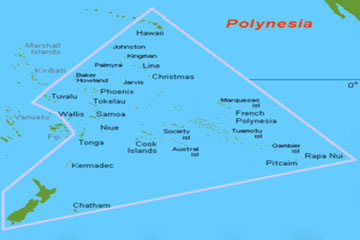
The many islands of Polynesia in the Pacific give us the opportunity to appreciate how environment determines the path of societies.
Between 1200 BCE and 500 CE the Polynesian peoples dispersed over thousands of Pacific islands. They settled on islands that varied widely as to climate, geology, marine and land food resources, topography, and isolation. In all cases, the entire culture they took with them was the same, but what they could retain of it was determined by the new environment.
“History followed different courses for different peoples because of differences among peoples’ environments, not because of differences among peoples themselves.”
The original Polynesians depended mainly on agriculture with tropical plants. Since this wasn’t possible in the sub-Antarctic latitudes (The Chathams, New Zealand’s South Island) those settlers had to abandon thousands of years of farming and become hunter-gatherers again. In contrast, those who settled on large, fertile, tropical islands with good sources of fresh water retained their entire culture. Islands with a combination of high mountains and steep valleys tended to develop several communities with little contact with each other. Coral atolls and limestone islands tended to have poor soil, so agriculture there was less productive and population numbers smaller.
Social complexity followed the same pattern. The simplest and most egalitarian societies were on the islands with low population density, they retained the original Polynesian custom of chiefs. Complexity peaked in Hawaii, which had the most productive agriculture. There people of chiefly descent were divided into 8 hierarchically ranked lineages. Chiefly classes were separated from commoners with no intermarriage and all the chiefly lineages, bureaucrats, and some craft specialists were freed from the work of food production.
Likewise with political organization, where population and/or density was low, chiefs had little authority. Decisions were reached by discussion and consensus. Land ownership rested with the entire community. As population numbers increased, so did chiefly authority, peaking in Tonga and Hawaii where power of chiefs equaled that of kings, including land control. On Tonga and Hawaii each entire archipelago was eventually united under a single chief and constituted an empire. Tonga eventually invaded Fiji. Its conquest of that area was only interrupted by arrival of Europeans.
Intelligence and Adaptability Is the Same in Farmers and Hunter-Gatherers
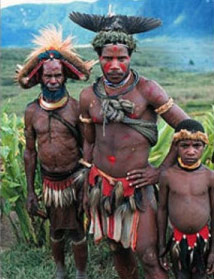
A look at locations such as the Eastern United States or New Guinea quickly proves this point. Hunter-gathers had to know the names and uses for all locally available plants and animals. Ethno-biologists’ studies have shown them to be extremely skilled in knowing names and uses for as many as 1000 or more plant and animal species.
In both New Guinea and the Eastern US, limits on indigenous food production depended entirely on local biota and environment. In Eastern US four plants were domesticated between 2500 and 1500 BCE, but they were insufficient and served only as minor supplements to hunting and gathering. Between 500 and 200 BCE, three more seed crops were added. All seven were high in protein (17-32%), two were also high in oil. But there were disadvantages, four had tiny seeds in low volume, one is a wind pollinated relative of ragweed which causes allergies and skin irritations and smells bad. Agriculture finally took hold soon after CE 1 when Mexican crops began to reach Eastern US, and by 1100 CE, the Mexican trinity (corn, beans, squash) led to greatly intensified farming and densely populated chiefdoms along the Mississippi and its tributaries. By the time Europeans arrived, all but two of the original crops had been replaced.
Food Production and Its Advantages
The factors that cause the tipping towards food production are subject of much disagreement and remain unsettled, partly because answers could be different in different areas and cause and effect get tangled. But these 5 reasons seem agreed on:

- Decline in the availability of wild food.
- Increase in availability of wild candidates for domestication (e.g. climate changes that increased the spread of cereals). One or two crops are not enough for hunter-gatherers to change their life style.
- Abundant wild cereal harvests led to development of technologies used for collecting, processing, and storing food.
- Increases in population led to increases in food production, which led to increases in population and increases in food production, in a repetitive cycle.
- The denser populations of food producers displaced or killed hunter-gatherers.
The result was that in most areas suitable for food production, hunter-gatherers were either displaced or they adopted food production. The only exceptions were where hunter-gatherers were separated by natural barriers in areas unsuited to food production, such as by deserts (California), by climate (the Cape of South Africa), ocean or other water (Australia), etc.
Characteristics Favoring Domestication
Plants which were already edible and plentiful in the wild and needed few mutations to adapt to farming were the earliest to be domesticated. Such plants needed to be easily and quickly grown from seed, produced in large quantities, and have a high caloric value. They needed to be suitable for storage, i.e. able to survive a long dry season and resume growing rapidly when the rains return.
Animal candidates for domestication also share a common set of characteristics which explains why almost all were Eurasian. Although many small mammals and birds have been domesticated around the world, only 14 species of big (over 100 pounds) mammals were domesticated before the 20th century. Of these, all but one (llama/alpaca) is native to Eurasia. There were no cultural obstacles to domestication in other locations. We know this because of the rapid acceptance of Eurasian domesticates wherever they were introduced. Lacking even one of these characteristics disqualifies an animal for domestication. They must:
- Convert fodder to human food efficiently.
- Breed in captivity.
- Live in herds with a well developed dominance hierarchy so that humans could replace the role of dominant herd leader.
- Have a pleasant and docile disposition able to be kept in large groups.
Territorial animals cannot be penned together or they will fight. Cats and ferrets were the only territorial animals domesticated and they were never used for food.
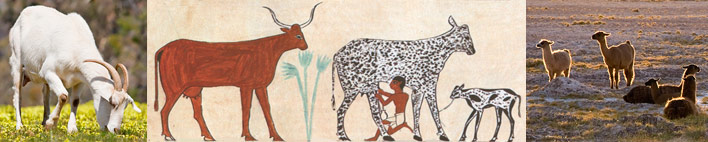
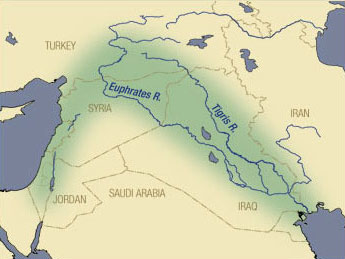
Western Eurasia, also called the Fertile Crescent, was an early center of the domestication of plants. Six of the twelve major crops of the world originated there. It had a Mediterranean climate with mild wet winters and long hot dry summers.
Why Didn’t Other Locations with a Mediterranean Climate Develop Indigenous Agriculture?
Food production arose around 8,000 BCE on the land that we know as the Fertile Crescent. The region offered hunter-gatherers exceptionally favorable weather and soil for intensive food production; its large size and variable climate meant a great diversity of wild plants and animals. Over half of the largest seeded grasses we know of originated in the Fertile Crescent; and four species of large herbivore mammals suitable for domestication were native to the area. People there had cereals for carbohydrates, legumes for protein, flax for cloth and oil, and large domestic animals for food, plowing, and transportation. In contrast, Mesoamerica had only two small domestic animals (the turkey and dog), and their corn was difficult and slow to develop. Other locations had even more limited options.
Geographical Advantage of an East-West Axis
Food production developed independently in as few as five areas of the world: Southwest Asia (the Fertile Crescent), China, Mesoamerica, the Andes and possible adjacent Amazon Basin, and the eastern United States. The ease of its spread varied greatly around the world. In general, it spread rapidly along east-west axes, where adjoining areas are in similar latitudes and so have similar seasons and climates: Fertile Crescent crops were able to move rapidly east and west to Europe, Egypt, North Africa, Ethiopia, Central Asia and the Indus Valley. Crops also spread east and southwards from China to Southeast Asia, the Philippines, Indonesia, Polynesia, Korea, and Japan.
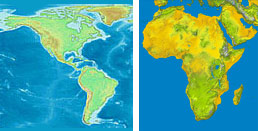
There was a comparatively slow spread along north-south axes, such as from Mexico northward to the Southwestern United States where deserts delayed the spread of Mesoamerican crops to the Eastern parts of the continent. Likewise, the tropical lowlands of Central America restricted the movement of crops and animals between the Mexican and Andean highlands. In Africa, the 2000 miles of tropical conditions south of the Sahara prevented the crops suitable for Mediterranean climates from reaching South Africa and slowed the movement of crops from the Sahel and West Africa to East and South Africa.
Of course, geographic and climactic difficulties inhibited the spread elsewhere as well. For example, east of the Indus Valley in India the shift from winter rain to summer rain meant that the same crops could not be used. The Central Asian desert, the Tibetan plateau, and the Himalayas isolated the temperate areas of China, a barrier partly overcome between 1000 and 2000 BCE when wheat, barley, and horses reached China from the west.
Food Production: Precursor to Technology, Central Government, Literacy and Germs
Many assume that Eurasians were superior in inventiveness and intelligence. But no difference in neurobiology exists to support this.
Food production was one of the greatest prerequisites for the development of guns, germs, and steel. Because food production is based largely on geographic variations, those with better agricultural land also developed advantages in these other areas.
Land cultivation increased the amount of calories available per acre. Large domestic animals pulled plows for crops, which allowed for more intensive farming, and increased mobility, which in turn allowed people to move greater distances more quickly and to carry more with them. Domestic animals replaced game as sources of meat and provided milk, yielding several times more calories over their lifetime, and also provided fertilizer, which increased plant growth. Populations increased as a consequence and more sedentary lifestyles associated with farming communities evolved, which resulted in shortened birth intervals because people no longer had to physically carry their children along with them as nomads. The birth intervals for farm peoples is around two years, half that of hunter-gatherers. Settled life permitted the storage of food. Reliable food surplus supported non-food producing specialists such as kings, political elites, priests, bureaucrats, professional soldiers, craftsmen and scribes.
Epidemic diseases require close-knit populations of more than 500,000 in which to develop and spread. The disease then shifts from one area to another, returning when there are enough non-immune children born for it to strike again. Farming provided these ideal conditions. Agriculture not only facilitated the dramatic increase in populations, it encouraged the domestication of social animals, such as cows and pigs, which carried the microbes that evolved into these human diseases.
Advantage of Disease and Immunity
Lethal epidemic diseases affected the Eurasians thousands of years before they journeyed to the New World, by which time they had developed partial genetic immunity to them, and inadvertently took those diseases with them wherever they went.
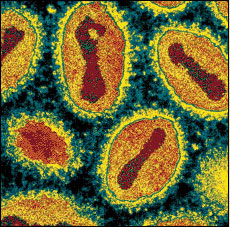
The importance of lethal microbes is well illustrated by the European conquest and depopulation of the Americas. Perhaps as much as 95% of the indigenous population was killed by European diseases, often long before there was any actual physical contact.
Infectious diseases (smallpox, influenza, tuberculosis, malaria, plague, measles, and cholera) are the major killers of people through most of history. The characteristics of epidemic diseases are:
- They spread quickly.
- They cause an acute illness from which a person either dies or recovers in a relatively short period.
- Those who recover develop antibodies that leave them immune for a long time, possibly for life.
Advantages of Early Technology
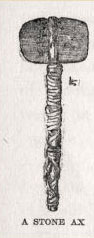
The first stone tools were developed 2½ million years ago. But unlike today, when technological advances are reported almost daily, hundreds of thousands of years passed before the next major advance.
There were two especially significant prehistoric leaps. The first occurred between 100,000 and 50,000 years ago and led to bone tools, single-purpose stone tools, and compound tools.
The second resulted from the adoption of settled lifestyles and the acquisition of food surpluses. This change allowed the accumulation of non-portable possessions such as large pots and looms and later the development of economically specialized artisans, which increased population density even more and led to increasing contact and competition between groups.
Technology of weapons and transportation are the direct means by which certain peoples have expanded their realms and conquered others. Writing was a particular type of technology which enabled conquerors to convey commands to distant fleets and to benefit from the experiences of previous expeditions. Written accounts motivated later expeditions by descriptions of wealth and fertile lands.
Writing appears to have evolved independently in four separate places: the Sumerians of Mesopotamia somewhat before 3000 BCE, the Mexican Indians before 600 BCE, in Egypt about 3000 BCE, and Chinese writing in about 1300 BCE. Early writing systems were combinations of alphabets and pictographs. Writing became necessary with the rise of highly complex societies with political structures and surpluses in food to quantify, store and trade.
Facts that led to Eurasian Technological Advances
Technological inventions diffused either because one society saw it and adopted it, or because the ones with the invention moved in and absorbed or displaced those without it.
Many assume that Eurasians were superior in inventiveness and intelligence, but no difference in neurobiology exists to support this. One theory holds that solitary geniuses, who did the inventing, happened, by accident, to be born Eurasian. However, most technology evolved cumulatively in small steps each building on those that went before. Another theory is that Eurasian societies were more receptive to invention while those on other continents were more resistant. Yet on every continent there are examples of some societies adopting a technology and others rejecting it; and these change over time.
Technological inventions diffused either because one society saw it and adopted it, or because the ones with the invention moved in and absorbed or displaced those without it. Historically, technological diffusion has happened in many contexts. For example:
- War: Papermaking was acquired by Arabs who captured Chinese papermakers in 75 CE
- Espionage: Silkworms were smuggled from Southeast Asia to the Middle East in 552 CE
- Emigration: French glass and clothing manufacturing spread throughout Europe with the expulsion of the Protestant Huguenots from France in 1685 CE
- Peaceful trade: Transistors were imported by Japan from the United States in 1954 CE
Isolation allowed a society to abandon a technology, as Japan did with guns in the 17th Century. No central European country could afford to do the same or they would have been overrun by their neighbors. Once the Japanese were forced into contact with the rest of the world in 1853, they immediately resumed the manufacture of guns.

Food production and population size, plus the presence or lack of geographical barriers to distribution determine differences in technological development. Eurasia was not only the largest landmass with the largest number of competing societies, it also had few geographical barriers. Food production began there earliest, so unsurprisingly, Eurasia was where technology started earliest and spread most widely; by 1492 the region’s advantages were huge by reason of geography not intellect.
Eurasia’s head start in technological advancements exaggerated the differences in innovation over time because, Diamond says “technology is self-catalyzing” – one invention accelerates another.
Politics: Small Groups to Large Societies
Government organized, religion justified.
The spread of governments and religions was linked throughout history, whether peaceful or not. Government organized, religion justified. The trend over 13,000 years was for nomads and tribes to lose. By 1500 CE, less than 20% of the world’s land area was marked into states run by bureaucrats and by laws. Today, with the exception of Antarctica, all land belongs to some state or other.
Some societies, no matter the size, were more successful than others and grew larger. Those with richer territory and better leaders grew more. As the density of population within a region increased, so did aggressive competition for land and resources. Two groups would merge together only when populations were so dense that the weaker group had nowhere to go to escape. Sometimes small groups joined to fight a common enemy, at other times a stronger society defeated a weaker one and incorporated it.
Attempts by anthropologists to define the developmental stages for societies are imprecise. Each stage grew out of the one before with the most dominant characteristics of one remaining in the next. However, a simple classification has been devised dividing political units into four classes, band, tribe, chiefdom, and state.
The smallest unit of social organization was a band, usually consisting of a small number of families living together cooperatively. Bands were egalitarian, with leadership acquired through personal qualities, not through heredity. Today autonomous bands exist only in remote regions, which lack the necessary resources to support larger groups.
Although a tribe might be numbered in the hundreds, everyone still had personal links to everyone else. Relatives or clan leaders were available to solve problems between individuals. This “big man” had some special decision making powers, but lived like his neighbors and his position was not hereditary.
When a tribe grew into the thousands it either split up or evolved into a chiefdom. The position of chief was hereditary. He and his family dressed differently from others, were exempt from food production, and had additional privileges as well as additional powers and responsibilities. Fully independent chiefdoms disappeared by the 20th Century because they tended to occupy prime territory.
Some chiefdoms grew into states—complex societies with multiple classes, large public works, and massive amounts of tribute. As populations grew to more than 50,000 people, levels of administration within each government grew more complex and specialized.
States were more than simply chiefdoms on a larger scale, they developed in new directions. The organization of early states was based on political and territorial lines, not kinship. They were often multiethnic and multilingual. Bureaucrats had to be selected at least partly on ability and training rather than solely on kinship. States now rule all the land areas of the globe. In many modern states, leadership is not necessarily hereditary and in some the entire system of formal hereditary classes has been abandoned.
Although they sometimes broke up into smaller units (recently USSR, Yugoslavia), or decayed and were overrun by smaller simpler ones (Rome), over the past 13,000 years the predominant trend has been toward larger and more complex entities, (as has happened in Italy and Germany over the past century and a half).
Advantage of Central Government
Complex centralized organization provided a recognized authority to solve disputes or conflicts between unrelated strangers. This function could no longer be served informally by family members or clan leaders because they no longer had links to all the parties involved. Centralized institutions were created to handle communication and decision-making, which formerly operated communally. With the increase in population density, the reciprocal transfer of goods no longer worked. More necessities had to be acquired from outside the individual territory, thus a complex economy evolved to redistribute goods between widely separated people and places.
Australia and New Guinea: Limited by Climate and Geography
Both Australia and New Guinea were settled during the Pleistocene ice ages when the ocean levels were low and temporary land bridges enabled people to come south from Asia. When the ice melted and oceans rose again, they were trapped. Although society and technology in New Guinea was more complex than in Australia, societies did not progress beyond tribes.
Why didn’t either of them go further? Although the two environments couldn’t have been more different, each had a geography that placed limits on the people living there.
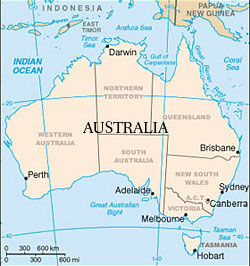
Yet 40,000 years ago, Australia was culturally ahead of Europe and other continents. People there had developed some of the earliest stone tools with ground edges, the earliest stone tools mounted on handles, and the earliest watercraft. Some of the world’s oldest known rock paintings are in Australia.
But the continent is low and flat and one of the driest places on Earth; its soil was mostly desert and dry woodland, the oldest, most infertile of any continent. There were almost no wild plants capable of being domesticated, and, soon after human colonization, large land animals became extinct. The climate and terrain were only able to support small bands of people who had to cover wide areas for hunting and gathering.
Aborigine Australians adapted to the harsh environment and exploited it to the fullest but they were prevented by it from further development.
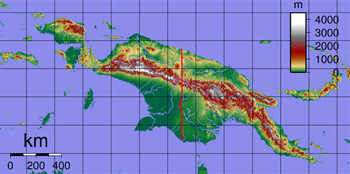
The large island of New Guinea is mountainous and rugged; its climate was equatorial and one of the wettest on Earth. Dense rain forest populated by numerous species of mammals and birds covered most of its surface. With many large permanent rivers, the soil was young, made fertile from volcanic and glacial activity; but, the island’s indigenous plants were low in protein and there were no large animals.
A few broad valleys in the highlands above 4,000 feet were capable of supporting dense populations. There New Guineans developed extensive agriculture which exploited all the possibilities offered by the location. But, since rugged mountain ridges separated communities from each other, only limited communication between them was possible. New Guinea’s total population never grew large enough to develop a complex technology, and the island landscape limited its importation from elsewhere. In fact, it wasn’t until airplanes flew over the high valleys of New Guinea in the 1930’s that westerners even knew that this part of the island was inhabited.
Europeans were unable to settle New Guinea as extensively as they did Australia because of the island’s diseases and its inability to support European food production. Australia was colonized by Europeans because its environment and people provided few barriers, and the English colonists did not create a literate, food-producing, industrialized democracy there, they brought it with them. Without their inherited technology, European settlers could not have survived.
In summary, Australia was settled extensively by white Europeans because it supported European food production and the indigenous population was virtually annihilated by guns, germs, and steel.
China: Relative Isolation and Early Unification
Five of the six most populous nations in the world achieved political unification only recently (USA, Russia, India, Indonesia, Brazil). The exception is China, which was unified by 221 BCE under the Qin Dynasty after literate Chinese states had absorbed the illiterate “barbarians” of their land.
The level of unity in China is astonishing. The climate and environment of North and South China differ considerably and there is more genetic variation among the Chinese than between the Swedes and the Italians. China’s size and ecological diversity gave rise to a number of different peoples and local cultures, which eventually grew in size and competed with one another. China became politically unified much earlier than other regions. It took over a huge region, repopulating tropical Southeast Asia and influencing Japan, Korea, and perhaps even India. This advanced the growth of their technology and political structure, and accelerated cultural unification.
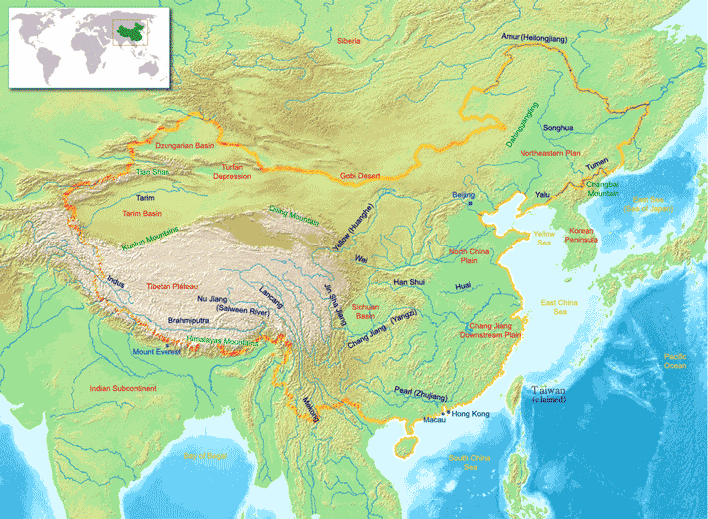
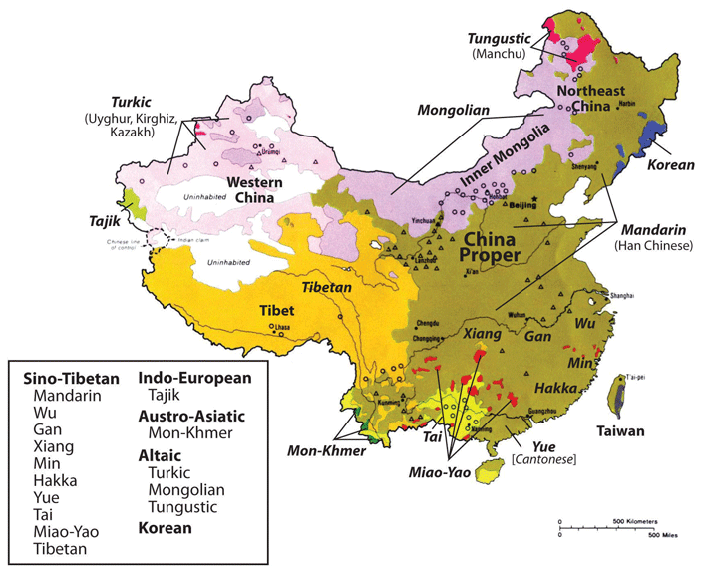
Also, China has only ever had a single writing system, whereas modern Europe has many. In addition to China’s eight most widely spoken languages, there are also more than 130 smaller languages. Yet Mandarin Chinese has spread throughout the country: over 800 million of China’s 1.2 billion people speak Mandarin.
As we would expect, there is evidence of food production in China as early as 7500 BCE. The earliest identified crops were two drought-resistant species of millet in North China, and rice grown in South China, suggesting two different agricultural developments. These same sites also contained evidence of bones from pigs, dogs, and chickens.
China benefited from the ease of east-west expansion, adopting domestic animals such as cattle and horses. Here again food production contributed to the early development of complex cities and technology. The earliest cities found to date were built around 2000 BCE, before written documents became available, and some of the oldest cast-iron vessels found date about 500 BCE. The following 1,500 years saw an outpouring of Chinese inventions: paper, the compass, the wheelbarrow, and gunpowder.
Polynesia: Population Expansion from China
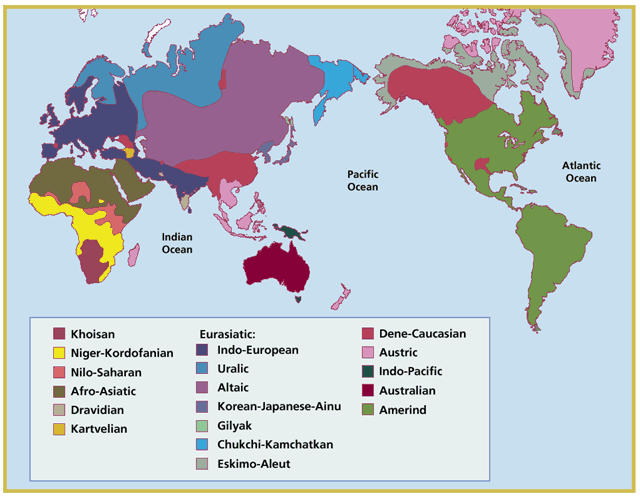
The Austronesian Expansion, which began around 4000 BCE was the largest population movement in the last 6000 years. It led to the colonization of over half the globe, from Madagascar off the coast of Africa to Easter Island in the Western Pacific. It populated Java and parts of Indonesia, the Philippines, Malaysia, and all of Polynesia.
Languages give us clues to the route of the expansion. There were 4 sub-families of Austronesian languages, three of which were found only among the aborigines of Taiwan. One sub-family covered all the rest of the area. The longer a language is in a place and separated from its relatives, the greater the differences it has from them. This suggests Taiwan as the original home of the Austronesians and that the expansion began in Taiwan and spread south to New Guinea, east to Hawaii, and west to Madagascar.
The Austronesians were in Taiwan by 4000 BCE, in the Philippines by 3000 BCE, New Guinea by 1600 BCE, and throughout the Pacific and to Madagascar by 500 CE.
Austronesians replaced hunter-gatherers in the Philippines and Indonesia in a similar way that the Europeans replaced native Australians. They were farmers with denser populations, superior tools and weapons, more developed watercraft and maritime skills, and epidemic diseases. In New Guinea they were only able to colonize about 15% of the island because the existing New Guineans were already farmers and toolmakers and had some resistance to the diseases of the Austronesians. Europeans were only able to colonize in significant numbers the largest and most remote islands nearest the temperate zones (New Zealand, New Caledonia, and Hawaii). The rest remained occupied by East Asian and Pacific peoples.
The Americas: Population Replacement by Europeans
The largest population replacement of the last 13,000 years was the result of the collision between the Old World and the New World.
As we would by now expect, the reasons that Europeans colonized the Americas, and not the other way around, stems primarily from differences in their abilities to produce food, particularly the following:
- Geography in the Americas also prevented unification. Fragmented by deserts, mountains, and rain forests, the three regions of settled cultures—Southeastern United States, Mesoamerica, and the Andes—were never connected in the trade or conflict that transmits disease, technology and complex weaponry. The lack of cultural diffusion, competitive pressure, and cross-fertilization of ideas slowed or stopped inventions. For example, Mesoamericans discovered the wheel, but the only large mammal capable of pulling a wheeled vehicle (the Llama) lived in the Andes. The two never got together.
- Eurasia had access to large domesticable animals that boosted agriculture and provided transportation, whereas the Pleistocene extinction killed off the majority of large mammals in the Americas.
- Plant food production was more prolific in Eurasia, and more people had turned from hunting and gathering to agriculture. In the Americas farming remained supplemented by hunting and gathering for a long time, and settled villages arose thousands of years later than in Eurasia.
- Agriculture in the Americas was constrained by these major disadvantages: wide-spread dependence on protein-poor corn, which also required a long time to evolve from its wild ancestor to a productive domesticated version; tilling and planting had to be done by hand instead of plowing, lack of animal manure to increase soil fertility, and relying on human muscle power rather than on animal power.
European density of population led to organized states made up of polyglot amalgamations formed by conquest of other states. These, in turn, led to empires. Many had official religions which increased cohesion, legitimized rulers, and sanctioned war against others. The Americas had two empires (Aztec and Inca), Europe had seven which went on to acquire American colonies (Spain, Portugal, England, France, Holland, Sweden, and Denmark). The Americas had many chiefdoms in tropical South America, Mesoamerica (beyond Aztec area), and Southeastern United States, the rest was at the tribal or band level of organization.
The first American contacts with Europeans were with the Norse from Greenland in 874 CE. These people were, however, too few, too poor, too early, and too far north to make successful settlements. By the time of the second invasion in 1492, Eurasia had had 5,000 years of food production. This time travelers came from Spain, a state rich and populous enough to support exploration and colonies. Existing populations were quickly decimated by disease, dispossession, enslavement, warfare and murder. Where large native populations did survive (Andes, Central America) culture and language were extensively replaced with European ones. The conquest of the Inca by the Spanish is an example of what happened when Eurasian societies invaded other lands.
Most Eurasian states had literate bureaucracies and in some a significant proportion of the population was also literate. Writing facilitated political administration and economic exchange, motivated and guided exploration and conquest. In the Americas, only the elite in a small area of Mesoamerica were literate. The Incas had an accounting system and a mnemonic device based on knots.
The Europeans had ships and sailing know-how, the Inca did not. The Spanish could finance, build, staff and equip the ships. Written records gave them information about previous voyages and conquests, the environment, and the native peoples. The Inca had little or no information about the Spaniards; they were ignorant of their previous successful conquest of Central America.
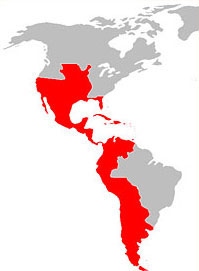
The Spanish arrived with guns, armor, steel swords, horses; the Inca had only stone, bronze or wooden weapons and no mounted troops. The earlier Central American conquest brought a smallpox epidemic that spread south from Panama well ahead of Pizarro, drastically reducing the numbers of Inca troops and killing the emperor and many of his court. The ensuing civil war meant there was no unity of command or information about the Spaniards; they were ignorant of their previous successful conquest of Central America.
The population of the Americas is now ten times what it was in 1492 because of immigration (voluntary and not) from Europe, Asia, and Africa.
Africa: History, Diversity, and the Advantage of Agriculture
As a result of geography and a long prehistory Africa was the most diverse continent, and very different people may have occupied much of modern black Africa until a few thousand years ago.
Up to the time of European colonization, Africa had five of the world’s six major divisions of mankind, three of which were exclusively in Africa: blacks, whites, African pygmies, Khoisans, and Asians.
Blacks in the south and whites in the north were mostly farmers or herders or both, separated by the Sahara Desert. African pygmies were hunter-gathers scattered through the central rainforest. The Khoisan were hunter-gathers and herders distributed over much of the south.
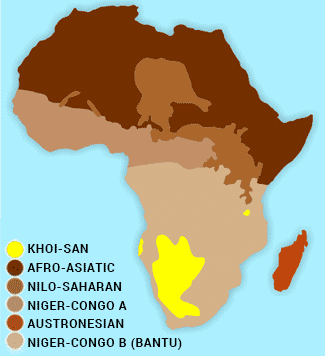
Ultimately, black Africans came to dominate the area south of the Sahara. To understand how that came about, we can look to the current distribution of Africa’s five linguistic families: Afro-Asiatic—North African—including the Semitic languages, Niger-Congo including Bantu, Nilo-Saharan, Khoisan and Austronesian.
Of the five groups of people, only the Pygmies now lack a distinct language, but there are indications that they had distinct languages in the past. Nilo-Saharan distribution is fragmented. Khoisan is currently confined to South Africa except for two groups, which are in Tanzania, 1000 miles from South Africa.
Tracing the Niger-Congo languages shows that the black speakers of the Bantu subgroup began expanding from West Africa as early as 3000 BCE. They spread through most of sub-equatorial Africa and replaced, surrounded, and pushed south the other groups.
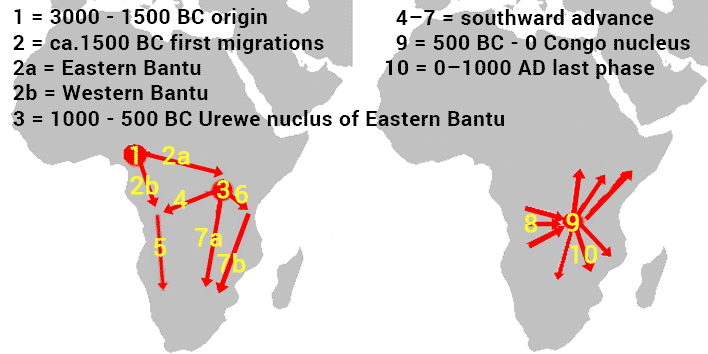
The Khoisans and Pygmies failed to develop agriculture due to the lack of suitable candidates for cultivation and later to being confined to unsuitable areas by invaders. Their only domesticated native animal was the guinea fowl. None of the large native mammals of sub-Saharan Africa was suitable for domestication.
The Bantu had several advantages which allowed them to move into the rest of tropical and subtropical Africa and displace the people there. Mediterranean crops, even if they could cross the Sahara, were ill suited to the climate of the area, with its summer rains and little variation of light across the seasons. A set of African crops from the Sahel, the highlands of Ethiopia and West Africa, domesticated in this region. Other crops came from Asia, possibly via the Austronesians on Madagascar. All of these crops originated north of the Equator, as did the Bantu people.
Smelting of metal most probably arose independently with the Bantu, whose techniques were very different from those of North Africa. They were making steel 2000 years before Europe and the Americas. Iron tools and agriculture created an unstoppable military-industrial package for the Bantu.
Because the Khoisan already had cattle and sheep, the initial Bantu colonization was only in the wet areas suitable for West African crops, leaving the drier areas to the Khoisan. However, gradually the Bantu multiplied and incorporated cattle and dry climate crops. There was also intermarriage with the Khoisan people.
Within a few centuries, the Bantu had reached Natal on the eastern coast of South Africa. Their expansion only stopped when it reached the Fish River in South Africa. From there the climate turns Mediterranean with winter rains, and their crops did not do well.
When Europeans arrived in South Africa, they easily displaced the remaining Khoisan in the Mediterranean areas, but when they tried to move East they encountered a dense population of steel equipped Bantu farmers. It took 9 wars and 175 years for the Boers to subdue the Bantus.
Europeans eventually colonized Sub-Saharan Africa because of superior technology (guns), widespread literacy, and political organization necessary to sustain programs of exploration and conquest. Food production was delayed in Sub-Saharan Africa because of the lack of domesticable native animals and plants, and because it was a smaller area than Eurasia with a North/South axis, which, as we have seen, retards the spread of food production and inventions. The large mammals of the region have occasionally been tamed (elephants) but can not be domesticated, i.e. bred selectively in captivity and genetically modified to increase usefulness. Pottery, recorded in Sudan and the Sahara around 8000 BCE, did not reach the Cape until 1 CE. Writing developed in Egypt by 3000 BCE and spread south into Nubian kingdom of Meroe and into Ethiopia. But writing did not reach the rest of Africa until brought by Europeans and Arabs.
Cultural and Individual Idiosyncrasies May Also Affect Societies
Even today, when information travels rapidly and an invention in one place can create a thriving industry elsewhere, the old rules still seem to apply. Places with an early advantage in food production—or areas settled by their people—still have the developmental advantages of literacy, metal machinery, and centralized government. They continue to be the best equipped to adapt and benefit from new technology.
It’s clear that geography and climate favorable to the production of more and better food, and subsequently to larger, more complex societies and advanced technology gave the Eurasians a distinct advantage in their conquests. But there are still many unanswered questions about the impact of cultural idiosyncrasies on a society.

The early societies of the Fertile Crescent and the Eastern Mediterranean arose in a comparatively fragile environment and eventually committed ecological suicide by destroying their own food resources. As a consequence power shifted gradually westward to Northern and Western Europe which has a more robust environment with more rainfall.
Once China was unified in 221 BCE, no other independent state ever had a chance of arising or persisting for long. So the connectedness and unity of China gave it an initial advantage, but later that unity became a disadvantage because of the lack of competition. This allowed despots to stop innovations and/or destroy an industry, and they did.
Did linguistic or cultural factors prevent the Andean culture from developing writing? Was there anything in India’s environment which led to the rigid socioeconomic castes that had serious consequences for the development of technology? Was there anything in the Chinese environment leading to the dominance of the culturally conservative Confucian philosophy? Or did anything in Europe and West Asia predispose toward proselytizing religions of Christianity and Islam and the dynamic of conquest?
And what is the effect of individuals on social development—are we just “riding the coattails” of our times or can we really change events?
Exploring these questions could have a significant impact on our future.
About the Book’s Author: Jared Diamond is a professor of physiology at UCLA School of Medicine. He is a recipient of a MacArthur Foundation Fellowship and was awarded a 1999 National Medal of Science. He is also the author of The Third Chimpanzee and Collapse.

500 Years Later, Scientists Discover What Probably Killed the Aztecs
The Guardian
In 1545 disaster struck Mexico’s Aztec nation when people started coming down with high fevers, headaches and bleeding from the eyes, mouth and nose. Death generally followed in three or four days. Within five years as many as 15 million people – an estimated 80% of the population – were wiped out in an epidemic the locals named “cocoliztli” meaning pestilence. It’s cause has been questioned for nearly 500 years.
Featured Book:

Foragers, Farmers, and Fossil Fuels
Ian Morris
Human social development, says Morris, is constantly generated by environmental and social factors. The amount of energy that can be extracted from the environment through technology defines the social possibilities, and thus influences the attitudes and world view of each epoch.