
Pre-Axial Thought
China
Chinese civilization dates back 5,000 years to mythical and legendary individuals who ruled the fertile Yellow River valley of what we know today as China. These pivotal figures established the basic ethos of Chinese culture and would influence the great Axial Age thinkers of the region over 2,000 years later.
There is no historical evidence, archaeological or otherwise, that supports this ancient Chinese history, from the Three Sage Kings to the end of the Hsia Dynasty. The earliest comprehensive history of China, tracing Chinese history about the period in question (from 2800 BCE), are The Records of the Grand Historian and The Bamboo Annals. But these were not written until the 2nd century BCE, by the Chinese historiographer Sima Qian. Yet, like the Homeric legends of Ancient Greece, the power of these tales became a cultural memory many centuries ago and in doing so established what was important, even more important than archeological findings.
Whether based on historical fact or myth, the stories of these ancient monarchs held important symbolic value for the Chinese, explaining why their culture evolved and providing standards by which later people could judge their own values and behavior.
The Three Sovereigns and the Five Emperors
3500 BCE to 2000 BCE
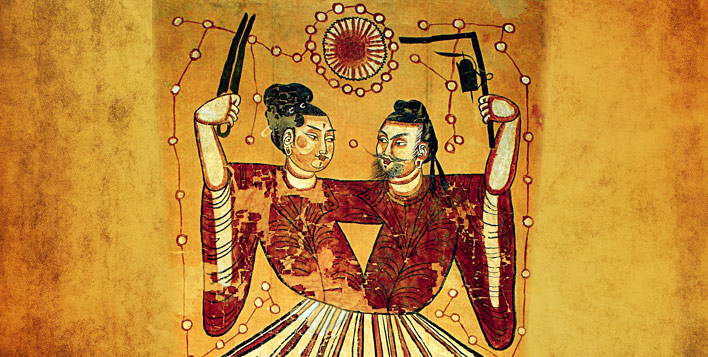
Painting of Nü Wa and Fu Xi
unearthed in
Xinjiang (Tang
Dynasty 651-676).
Fu Xi, Shennong and Suiren are the mythical Three Sage Kings. Sheenong was followed by the first emperor Huangdi. The five emperors Huangdi, Zhuanxu, Diku, Yao and Shun are collectively known as the Five Legendary Rulers (or Five Emperors).
Fu Xi (also written Fu His; pronounced “foo shee”) is first in this illustrious group. Han dynasty scholars dated his reign to the middle of the thirtieth century BCE. Today scholars call him a legendary chieftain. The story goes that Fu Xi taught “the black-haired people” (the proto-Chinese) how to hunt and fish and raise domestic animals.

Tibetan “Mystic Tablet” containing the Eight Trigrams on top of a large
tortoise (presumably, alluding to the animal that presented them to Fu Xi),
along with the 12 signs of the Chinese Zodiac.
Fu Xi is given credit for devising the “eight trigrams,” which are the basis for the sixty-four hexagrams that make up the kernel of the most ancient Chinese text, The Book of Changes (Yi Jing or I Ching). The legend goes that Fu Xi set out to make a thorough study of everything in heaven and on earth. At one point he observed a river dragon (some say an ancient tortoise) with strange markings on its back and from these he got the idea for the trigrams. He used a combination of lines to represent certain elemental forces: Heaven, Earth, Thunder, Wind, Water, Fire, Mountain, Lake. All sorts of systems of associations have been spun out from the trigrams ever since.
Nü Wa (sometimes written Nü Ga or Nü Go) is a female protagonist in these fragments of the early stories. Sometimes she is Fu Xi’s sister, sometime his wife. Click here for more information on Nü Wa.
In the enigmatic Han Dynasty tomb paintings, Fu Xi and Nü Wa are shown as human figures from the waist up with intertwined snakes’ tails and a child between them.
Nü Wa and Fu Xi as depicted on
mural from the Han Dynasty
(206 BCE - 220 CE)
One story makes Nü Wa the creator of humankind. As she wandered the pristine earth still devoid of people, Nü Wa felt lonely, so she mixed earth and water to fashion figures out of mud in her own likeness, and then brought them to life to keep her company.
The best-known story is called “Nü Wa Patches the Sky.” Two gods were fighting across heaven and earth. The defeated god, in anger, struck his head against a mountain and caused one of the pillars holding up the sky to collapse. The sky broke and cataclysms followed on earth: earthquakes, forest fires, floods welling up from the earth, rampages by ferocious animals against the human beings.
Nü Wa melted down various kinds of colored stones in a crucible, and patched the hole in the sky. She killed a giant tortoise and used its legs to prop up the fallen part of the sky. She put an end to the floods ravaging the earth and killed a dragon to overawe the beasts and put an end to their attacks on humans.
Depiction of Shen Nong ploughing the
fields as seen on a mural painting
from Han dynasty.
Shen Nong (also written Shen Nung; shen sounds like the English word shun, and the o in nong sounds like oo in foot) came after Fu Xi. He is said to have reigned for more than a hundred years, beginning in the 29th century BCE.
The name “Shen Nong” translates as “Spirit Farmer.” He was the inventor of agriculture and made the first plow. He founded the first market centers and showed the people how to trade with each other for mutual advantage. He made exhaustive studies of the plant world and discovered the medicinal properties of many herbs. In later legends he is the discoverer of tea.
Suiren, the last of the Sage
Kings discovered fire.
(Image from The Dragon,
Image, and Demon by Hampden
C. DuBose, London 1886.)
The Yellow Emperor (in Chinese: Huang Di, pronounced “hwahng dee”) arrived on the scene eight generations after Shen Nong. He came to power by defeating a corrupt king and winning the allegiance of all the powerful lords. He went on to reign for a hundred years. Many of the Yellow Emperor stories are about his wars with rival chieftains who tried to invade his territories.
Depiction of unknown origin of
Huang-di,
“The Yellow Emperor”.
The Yellow Emperor was seen by later generations as the paragon of a ruler. He chose to surround himself with talented advisors, whatever their background, who are credited with many epoch-making achievements. They developed mathematics and astronomy and established the historical calendar based on a sixty-year cycle, which is used throughout Chinese history. They invented a system of writing and promulgated a code of written laws, and invented the classical musical scales. They improved techniques of building and tool-making, and invented new measuring instruments.
The Yellow Emperor’s name is attached to the most ancient Chinese medical text, which presents discussions between the Emperor and his court physician on the diagnosis and treatment of diseases. His wife Lei Zu devised the techniques of rearing silk worms and weaving cloth from silk.